Having worked in satcom for around 20 years, I’ve seen a tremendous amount of change. One of the most significant came when satcom’s biggest customer base, broadcast, began to move towards IP because traditional satcom was viewed as too expensive and not flexible enough to meet the needs of an industry, itself in a state of flux. Then if that wasn’t enough to shake up the industry, new entrants have entered the satcoms sector which has completely changed the game for traditional providers, making for an extremely turbulent time for many.
These challenges have forced the satellite industry to adapt and innovate. Yet while the industry is very different from what it used to be, in my view, its role is evolving rather than reducing. We know that demand for connectivity is continuing to increase (and with no end in sight), yet both IP and 5G have their limitations. This has cemented satcom’s seat at the table in the network of networks era that we are inevitably heading towards. Lots of new applications for connectivity are being discovered all the time and innovation is happening at pace.

Helen Reynolds
Account Manager, Radical Moves Ltd
The Starlink Effect (or should that be the Musk effect?)
Just as Tesla has changed the automotive industry forever, Starlink has had a profound impact on satcom. With Tesla, Musk made electric cars desirable in a way that they just weren’t before: the brand’s innovative technology focused design showed that electric vehicles could be both stylish and high performing. Added to that, by selling direct-to-consumer, the brand created a simplified sales experience for customers, disrupting the traditional dealership model.
Starlink has been equally disruptive for satcom. With Starlink, SpaceX create an entirely different user experience for consumers. It delivered lower latency and lower costs with higher bandwidth and speeds, along with a simplified sales and onboarding experience that allowed users to order the antenna and plug and play straight out the box.
Starlink blazed a trail and other operators such as Amazon LEO are following which will no doubt cause further disruption. Traditional satcom providers have been forced to reassess what they offer because in the blink of an eye, everything has changed and traditional services no longer meet the evolving needs of consumers. This has created in a sense what can be likened to an existential crisis for many traditional operators.
However, just like in the automotive industry where car manufacturers have been forced to innovate and innovate fast in order to seize new opportunities and stay relevant, satcom operators, service providers and technology vendors must also do the same.
Innovation is the key
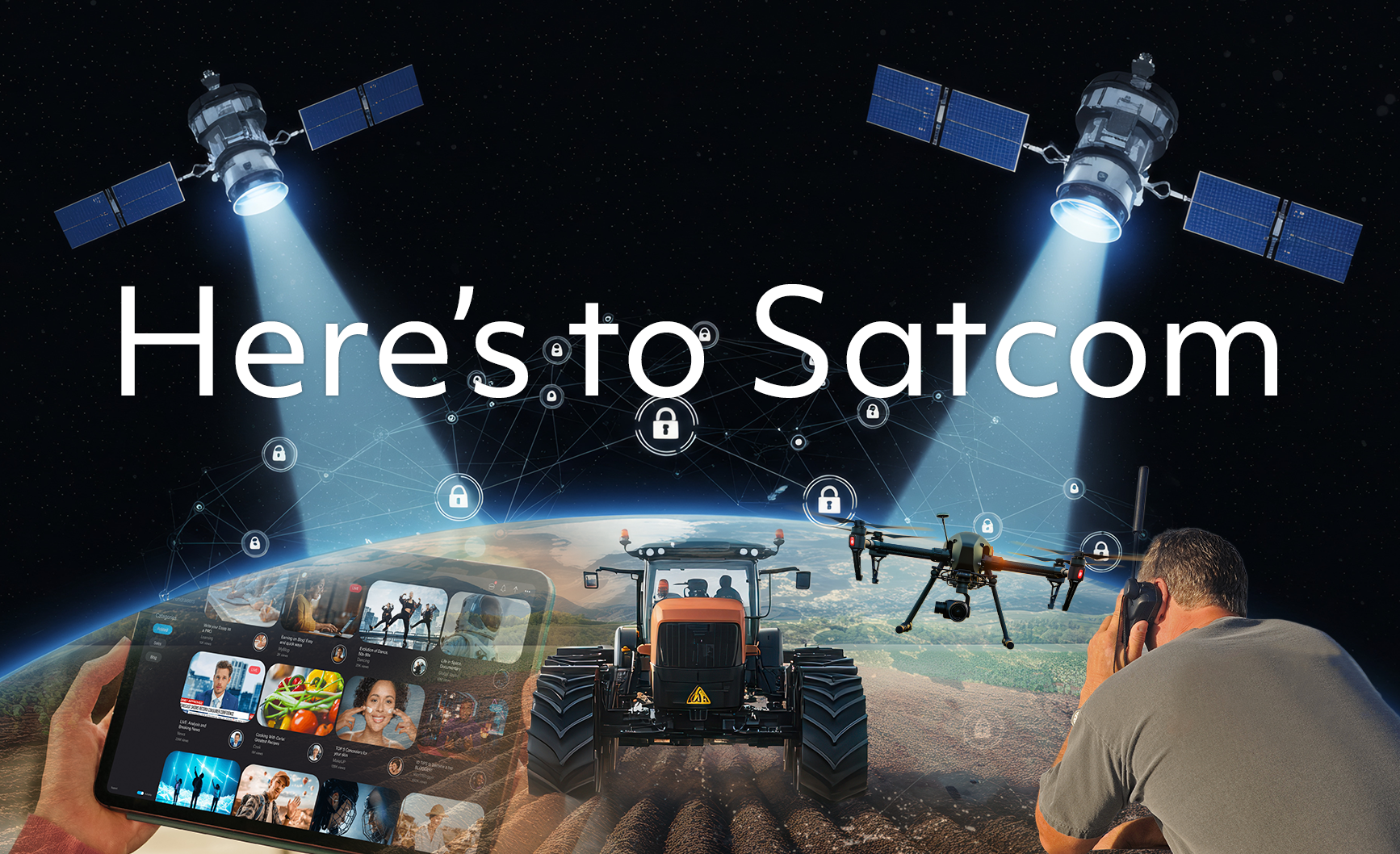
Whole new use cases for connectivity are coming to light across areas such as agriculture, urban planning, autonomous transport, energy networks, maritime, air travel, and public safety, enabled by the newfound ability to send data in real-time or very near real-time and at low costs. In agriculture for example, satellite connectivity can be used to enhance crop management allowing farmers to monitor field and soil conditions and plant health in precision detail, and in livestock management, sensors can be attached to animals which can tell farmers if they are sick or stressed.
Satcom technology is evolving at an unprecedented pace as the industry races to adapt to meet its customers’ changing needs. The growing demand for flexible and resilient technology able to operate across LEO, MEO, GEO and HEO, as well as multi-bands, and even multi-networks is driving innovation. The industry is increasingly shifting towards being software-driven with satellites featuring splitable and steerable beams that can be configured in real-time in response to changing requirements, and software driven ground infrastructure with hardware that can also be configured on the fly. We’re also beginning to see more services such as ground stations becoming available on the cloud in the form of ‘As-a-Service’ models.
A hyperconverged future
It’s also become clear that no single network can possibly meet the needs of all users’ diverse requirements. The goal has to be a hyperconverged network where satellite and terrestrial systems are all integrated seamlessly to provide users with fast and seamless connectivity wherever they are. In this network of networks, LEO, MEO, GEO and HEO will all have an important role to play, and operators will need to utilise them all effectively to deliver the most value to customers.
To truly seize this opportunity, the industry needs to accelerate innovation, particularly in the ground segment, ensuring that the ground segment can support all of the exciting opportunities that innovation in the space segment is opening up. This will require the ground segment virtualising and digitising its infrastructure as much as possible, which will pave the way for greater operational efficiency, as well as enhanced scalability and flexibility.
How you view all of the changes in satcom really depends on whether you’re a glass half empty or glass half full kind of person. I am very much of the half full outlook and firmly believe that while it’s a challenging time for traditional operators, it’s also very exciting and provided the industry focuses on innovating where its needed, the future looks very bright indeed.